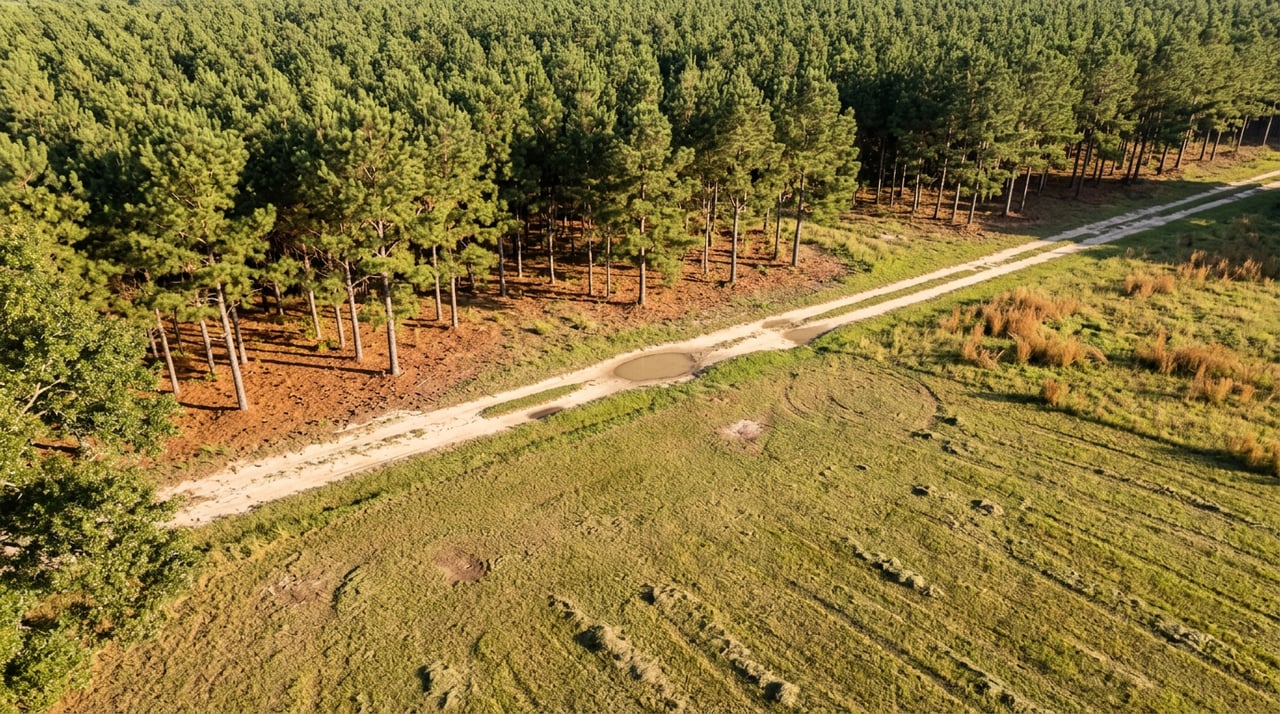
Two tracts, both close to Sylvania, both wooded, both a reasonable drive from downtown. One lists for a little under $5,000 an acre. The other, three miles away, lists for $20,000 an acre. If you're comparing land the way you'd compare houses, by price divided by size, you'll spend a weekend convinced one of these numbers has to be a typo. It isn't. The gap is real, and it usually doesn't show up until a title search or a call to the tax assessor's office, which is later than most buyers want to find out.
Here's the actual comp: a 90.4-acre recreational tract off Highway 17 between Oliver and Cooperville, listed this summer at $450,000, works out to $4,978 an acre. A separate 34-acre parcel closer to town, marketed as subdividable in pieces from 3 to nearly 35 acres, is priced at $20,000 an acre. Same county, same rough distance from Sylvania's downtown, four times the price. Something other than dirt is being priced here.
It's Not Location. It's Category.
Pull enough listings and a pattern shows up fast. Land near Sylvania sorts into rough tiers, and the tier matters more than the address:
- Undeveloped, raw acreage near Sylvania averages around $4,002 an acre in current listings, based on roughly a dozen active tracts.
- Screven County land overall, blending farms, timber, and hunting ground, averages closer to $6,261 an acre.
- Hunting-specific tracts in the county run higher on average, near $8,435 an acre, reflecting the premium buyers pay for managed timber stands and established food plots rather than raw acreage alone.
- Houses sitting on acreage, where the price includes a home, averages $42,551 an acre.
- Blend all categories of land near Sylvania together and you land around $18,553 an acre, a number that describes no actual property because it averages tracts that aren't comparable to begin with.
That last point is the one worth sitting with. An $18,553 blended average isn't a market price the way a median home value is. It's an average of two different products, agricultural or timber land taxed one way, and residential-adjacent land taxed and used another way, mashed into a single figure. If you're comparing a bare 20-acre tract to that blended number, you're comparing it to something it was never priced against.
The Number Nobody Puts In The Listing
The reason raw acreage prices so much lower per acre than land with a house on it isn't just that houses cost money to build. A meaningful share of Screven County's farmland and timberland sits inside a Conservation Use Valuation Assessment covenant, known locally and statewide as CUVA. It's a Georgia program that lets landowners get their property taxed at agricultural or timber value instead of fair market value, in exchange for a promise to keep the land in that use for ten years.
The tax break can be significant, which is exactly the point. Georgia built CUVA so a landowner sitting on land near a growing area wouldn't get taxed off their own farm just because nearby development pushed up what the land would fetch on the open market. It works. It also means a parcel enrolled in CUVA is carrying two different values at once: a low one for tax purposes, and whatever the open market would actually pay if it sold for development. That daylight between the two numbers is baked into the low per-acre asking price on raw land. Sellers holding CUVA-enrolled acreage often price closer to current-use value because that's the value they've been living with, not because the land is worth less to a buyer with different plans.
One Screven County timber tract listing made this explicit in its own marketing, noting the property had been entered into its CUVA covenant back in 2013 and again in 2016, and citing the resulting property tax reduction as a selling point. That's not hidden information. It's just information most buyers don't think to ask for until someone brings it up.
What Happens When The Numbers Don't Match
Here's where it becomes a transaction issue and not just a curiosity. The covenant runs with the land, not with the person who signed it. Buy a parcel under an active CUVA covenant and you inherit the remaining years of that commitment whether you knew about it or not.
If your plans line up with the covenant, keeping the land in timber, leasing it for row crops, holding it as a hunting tract, you're fine. You can typically step into the existing covenant and keep the lower tax bill going. Georgia's rules also protect family transfers: passing covenanted land to a relative who continues the qualifying use generally doesn't trigger a penalty, and neither does a sale to another buyer who agrees to continue the covenant.
The trouble starts when plans don't match. Multiple Georgia county tax assessor offices, including Columbia, Oconee, Barrow, and Morgan counties, describe the same penalty structure: breaking the covenant early costs the landowner twice the tax savings accumulated since the covenant began, plus interest. On a small tract with a few years under covenant, that might be a few thousand dollars. On acreage that's carried the covenant for most of its ten-year term, or on a larger tract, the number climbs fast, and it's owed by whoever is holding the deed the day the covenant breaks. If you buy raw land at a bargain price per acre with plans to subdivide it into homesites, and the land is seven years into a ten-year CUVA covenant, that bargain price didn't include the bill you're about to inherit.
There's a second detail that explains part of the pricing gap between bare land and land with a house on it. Under Georgia's conservation use rules, the land underneath a residence is carved out of the covenant and valued at fair market rate on its own, separate from the surrounding acreage. That's a meaningful reason houses on acreage price so differently per acre than raw tracts. The home and its footprint were never part of the tax break to begin with.
When The Covenant Works In Your Favor
None of this means covenanted land is a problem to avoid. For a buyer who actually wants what the land already is, a working timber tract, a leased hay field, a hunting property you intend to keep hunting, an active CUVA covenant is closer to a gift than a hazard. You inherit lower carrying costs on a property you were already planning to use the same way the previous owner did. The exceptions built into the program, for inheritance, for sale to another qualifying owner, for foreclosure or documented medical hardship, exist because Georgia designed this as a tool for keeping working land working, not as a trap for unsuspecting buyers.
The friction only shows up when a buyer's intent and the land's covenant status point in different directions. That's a conversation worth having with your attorney or closing team before you write an offer, not after your survey comes back.
Why Some Of This Land Is Priced Like It's Already Grown Up
Part of what makes Screven County land pricing confusing right now is that sellers and land brokers are actively marketing bare acreage using growth language usually reserved for suburban lots. One listing for a multi-generational farm near the Savannah River described the property as sitting in the path of growth from Savannah and near one of the nation's fastest-growing ports.
That framing has real numbers behind it. The Port of Savannah closed its 2026 fiscal year with June volumes of 483,684 TEUs, an increase of nearly 73,300 TEUs, about 18 percent, over the same month the year before. Screven County's own development authority puts Sylvania at roughly 55.5 miles, about an hour, from the Georgia Ports Authority gates via Highway 21, and the county already counts manufacturers like Milliken, Koyo Bearings, and Comp n Choke among its industrial partners, with workforce training available through Ogeechee Technical College.
That growth story is legitimate. It's also separate from what a parcel is taxed at today. A tract can sit an hour from a booming port and still be assessed at its current agricultural value under an active covenant with years left to run. The seller's optimism about future rezoning and the parcel's present-day tax status are two different things, and the gap between them is exactly where a buyer needs to slow down before assuming a low price per acre means a simple purchase.
A Few Questions Worth Asking Before You Write An Offer
Does every rural tract near Sylvania carry a CUVA covenant? No. Plenty of acreage has never been enrolled, and some land that was enrolled has already completed its ten-year term and rolled off. The only way to know is to check.
How would I find out if a specific tract has one? Screven County's Board of Tax Assessors keeps records showing whether a parcel is under an active covenant and when it started. A title search or a closing attorney handling the transaction should flag it, and it's a reasonable question to put to the seller or listing broker directly before you're under contract.
If I buy covenanted land, am I locked into farming it myself? No. You need to keep the land in a qualifying use, which includes leasing it out for row crops, timber, or other approved agricultural and conservation categories. The penalty only applies if you convert the land to a non-qualifying use, like a residential subdivision or commercial development, before the covenant's term is up.
Land math near Sylvania isn't broken. It's just pricing in a variable most buyers never learn to look for until it's already affected their deal. If you're comparing acreage and the numbers don't add up the way you expected, that's usually the signal to ask about the covenant before you ask about the survey.
Southland Realty & Properties, LLC works these details into every land transaction we handle, from checking covenant status before you write an offer to coordinating the closing once it's clear. If you're weighing acreage near Sylvania and want a straight answer on what a tract's price per acre actually reflects, reach out and we'll walk through it with you.